Showing posts with label Poetry. Show all posts

Saturday, June 11, 2016

Minn and Jake's Almost Terrible Summer by Janet S. Wong, Illustrated by Genevieve Cote


Synopsis: The second in the Minn and Jake series, this free-verse novel follows the friends into summer - a summer apart! Jake is visiting old friends and family in California, while Minn is all the way across the country! How are they supposed to be best friends when they can’t chase lizards together? Luckily, before things get too bad, Jake finds out Minn is coming to visit and everything seems great, until they go to Disneyworld and the happiest place on earth suddenly isn't...

Intended Audience: Boys and girls grades 3-5, likely those who have read the original Minn and Jake.


But it might also appeal to: Younger students as a read-aloud, or middle schoolers trying to forge friendships across that ever-frightening gender boundary.


Strengths: The style of the book - in verse - makes it accessible to newer readers and the images add a great deal of fun to the story. The message that friendship sometimes requires apologies is an important one for upper elementary and middle school students has they begin to have relationships outside of their families.


Weaknesses: Given that the novel is written in free verse, the author makes different style choices that readers of prose novels might not be used to: for example using italics instead of quotation marks to show who is speaking.


Special considerations: This is a companion to Minn and Jake. Not knowing the history of the friends made starting this one a big challenging, so it might be best to read this after the original!


Verdict: If the media center already has Minn and Jake, this would be an excellent addition as well -- its positive message about friendship, especially those between boys and girls, is valuable to kids of all ages! Wong’s unique style of free verse would also add to the diversity of any collection.


Wednesday, March 16, 2016

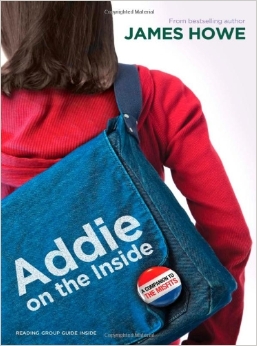
Addie on the Inside by James Howe


Grades 6 and up--

Intended audience: Middle school girls, GLBT tweens.

Audience to whom it will appeal: I think that much of this text could be relatable to boys as well as girls, though the initial interest would be difficult to attain given the cover and title. In order to promote this book to a wider audience, I would post some of the engaging, edgy poems from the book up in the Media Center. I think this book would also be an excellent and enjoyable read for parents or teachers of tweens or teens.
Strengths: Addie on the Inside realistically portrays the inner thoughts and emotions of tweens, both male and female. Addie calls middle school “purgatory…when so many things that never mattered before and will never matter again, matter.” Addie is outspoken, yet self-conscious, happy to be different, but wants badly to fit in; just like most of the middle schoolers I know. The anti-bullying sentiment sends a positive message and gives those wanting to speak up some literary courage. The author also incorporates a fair amount of homages to other YA novels and pop culture references, both of which give the opportunity to make connections outside of the text.
Weaknesses: For those who aren’t fans of poetry, the style of the novel may be a turn-off, although it alternates between free verse and rhyme-scheme poetry. Although I think the thinking, emotions, and experiences of Addie seem to be relatable to both boys and girls, the female voice of the narrator might be less appealing to male readers. The pop culture references are great, but they might be too specific to be accessible to readers in the next few years.
Special considerations: This novel is a companion to an anti-bullying series including The Misfits and Totally Joe that focuses on homophobia and GLBT issues. The books also cite and are supported by GLSEN (Gay Lesbian Straight Education Network). This would be a great book to use with a Gay-Straight Alliance in preparation for the National Day of Silence.
VERDICT: This is a book I would stock multiple copies of and would promote a large or small group reading of it for an anti-bullying group,GSA or even teacher PLC. This is a true middle school book and should grace the shelves of any and all middle school libraries.

Wednesday, March 2, 2016

The Crossover by Kwame Alexander

Grades 5 and up--
Written entirely in rap-style poetry, The Crossover by Kwame Alexander is a quick, enjoyable read. The story follows Josh and Jordan, junior high basketball superstars who also happen to be twins. The poems echo the rhythm of the sport; the book is even divided into four quarters. Along the way, the twins experience the rollercoaster that is adolescence: sibling rivalry, athletics, friendship and what it means to be a family.


Intended audience: Upper elementary and middle school African-American boys, especially those interested in sports, specifically basketball.


Audience to whom it may appeal: This book has the potential to reach a variety of people of all races, male and female, athletes and non-athletes. The unique poetic style of the book would also make for a fun read-aloud for younger students. Young people or adults interested in poetry will be inspired by the distinct writing style that incorporates free verse, slant rhyme, onomatopoeia, and shape poems.


Strengths: Pacing is quick, like adolescents’ attention spans, and its realistic themes of rivalry and relationships will appeal to young adults. The author incorporates high level vocabulary throughout the novel in a creative way that makes it accessible for readers of all levels. Winner of the Coretta Scott King Award and the Newbery Medal.


Weaknesses: Some of the basketball jargon may be lost on those lacking experience with the sport. Sometimes the poetic structure makes the narrative choppy and hard to follow. For dialogue, the author uses italics instead of quotation marks, which might confuse those unfamiliar with that style choice. Very few female characters.

VERDICT: Alexander shoots...and scores! This book deserves a spot in every media center: upper-elementary through high school. Reluctant readers, athletes and poets alike will enjoy this realistic, creative, accessible novel.

Monday, October 5, 2009

Joyful Noise: Poems for Two Voices by Paul Fleischman


This book is quite aptly named. What a wonderful use of onomatopoeia to create the sounds of the insects about which the poems are written! This book is written not just in two parts but for two people to read aloud. And read aloud I did. Fleischman does an excellent job of using rhyme schemes, imagery, metaphor, and spoken round (like "Row, Row, Row Your Boat...") to paint a beautiful scene for the reader. To be honest I've never really thought about bugs much, but I felt like I was back in the world of White’s Charlotte's Web where insects and animals can communicate and it was pretty great.
The use of metaphor and lyrical alliteration in the poems give the reader an appreciation and respect for the poet’s diction and the poems’ aesthetic appeal. For example in “Fireflies,” Fleischman writes, “Light/is the ink we use/Night/is our parchment…Insect calligraphers/practicing penmanship/six-legged scribblers” (11-13). Each of the poems is written from the perspective of a different insect or insects and it is a great exercise in switching perspectives. Fleischman's poems are not only aesthetically pleasing, but they also focus on common literary themes like growth, death and rebirth. And he is funny! One poem is a moth's serenade to a porch light and anyone who has enjoyed a sweltering summer night can relate to this and laugh: “Porch/light,/hear my plight!/I drink your light/like nectar/Dream of you/by day/Gaze in your eyes/all night/Porch light!” The moth’s language and feelings towards the light are comically reminiscent of the forbidden love of Romeo and Juliet: “ ‘Keep back,’ they say/I cant!/‘Don’t touch,’ they say/I must!” (19).
I also appreciated the poem about bees from the point of view of the worker and the queen at the same time-what an eye opener. (Part A is underlined, Part B is italicized, joint parts are left plain) For example: “Being a bee/is a joy/is a pain./ I’m a queen/I’m a worker…I’m bathed/then I take out/the hive’s morning trash/then I’m groomed” (30).
I would love to write a poem that describes a school day from my point of view and the point of view of my students and see what it looks like—or even my perspective as a student and a professor’s as a teacher. Book and insect lovers alike will appreciate "Book Lice," that follows a pair of wedded lice living and chewing their way through great works of literature by famous literary figures such as Conan Doyle, Keats, Horace, and Shakespeare.
I also really enjoyed Eric Beddows’ illustrations. They add a great deal to the text of the poems-he is an extremely talented artist. They really help to give Fleischman’s characters even more personality. As I was reading, I kept thinking that the poems sounded like song lyrics of some kind, and I actually discovered that some of them have been made into songs! This is a great interpretation of Moth's Serendade
--> set to music and performed by Shirley Hoffman Warren. What a great example of the many ways one can interpret poetry. After stumbling upon these songs, I looked into other work Fleischman has done, and I was really impressed! There are a number of his works that have been adapted for the stage and re-written as song lyrics. Visit Paul's Website for more information! I would recommend this book in pieces, these poems are meant to be savored one by one and definitely read it aloud! Happy reading!

19 Varieties of Gazelle: Poems of the Middle East by Naomi Shihab Nye


What an incredibly powerful collection! I have never been one to read a book of poetry from cover to cover, but this book kept me engaged throughout each poem like a set of short stories. I was constantly in awe of how much Nye could include in so few words. I felt as if every single poem, practically every single line told a different story.
I think the most pivotal aspect of the poetry was its metacognitive nature: she writes about writing and the power that comes with language. The way she talks about language and communication is incredibly powerful and really made me think about the importance of being able to communicate in one’s native language. This book combines elements of immigration, family, loss, war, peace and the struggle of being torn between two worlds: being an adult vs. being a child, being an American vs. being Arab, speaking English vs. speaking Arabic, living in war vs. living in peace and on and on. She talks about language as a way to express the pain and suffering of living between these two worlds. “The bombs break everyone’s/sentences in half,” she writes, emphasizing the power and violence of cultural destruction (61).
One of the other elements of Nye’s writing that I so enjoyed was her use of personification to emphasize the effect violence has on not only people, but places, things, and relationships. In the poem, “For the 500th Dead Palestinian, Ibtisam Bozieh” she writes about a girl who was killed at an extremely young age: “Dead at 13, for staring through/the window into a gun barrel/which did not know you wanted to be/a doctor” (53). She is treating violence as its own separate entity, a powerful being that can have feelings and emotions, but just chooses not to emit them. In another poem she talks about books and personifies them, but this time gives them emotions: “in Iraq a book never had one owner—it had ten./lucky books, to be held often/and gently, by so many hands/later in American libraries she felt sad/for books no one ever checked out” (110). This is another time in which she emphasizes the power of language and the importance of gaining and sharing knowledge. Following war, she says “certain words, feel impossible in the mouth./Casualty: too casual, it must be changed.” (35)
I really appreciated her focus on children and schools because I feel as though so many adults have written about the Middle East and their experiences, but their writing is not tangible for younger audiences. Nye writes about the experiences in such a way that they become so much more accessible for younger people. She talks about things like school, family and friends with which younger people are more familiar than say, Israeli-Palestinian conflict or strategies of war. For example in one poem she says, “I mighta have been dead too,/for something simple like staring/or shouting what was true/and getting kicked out of school” (53). She really made me think about how much I take my own schooling for granted. I can—and am encouraged!—to say what I think and believe in my classes and I feel safe in my school. Whereas in Nye’s world, “when students gather quietly/inside their own classroom/to celebrate the last day of school,/the door to the building/gets blasted off” (60).
Overall, I felt Nye’s collection was extremely well-written and eye-opening. I don’t know if I would say “enjoyable,” because so many of the poems were so sad, but they were important and that is why I liked this book. In post 9/11 society I think these poems would be a great way to start discussions about the relationship between the U.S. and the Middle East as well as the experience of immigrants in the U.S. Read these poems, but savor them individually, not all at once. Happy reading!

Monday, September 28, 2009

She Would Draw Flowers: A Book of Poems by Kirsten Savitri Bergh


This book of poetry is so incredibly heart wrenching and powerful. The book is comprised of poetry and drawings from the journals of Kirsten Savitri Bergh published by her mother after she passed away in a car accident at the age of 17. She and her family were from Minneapolis and she attended the Minnesota Waldorf school. The writing is absolutely beautiful and her language is well beyond her years. Because the poems weren't written necessarily to be published, the poetry is just that much more raw and emotional. You can really tell what an amazing, articulate and artistic person she was. She writes about everything from something as mundane as lime jello to the passing of her father when she was 16. She was also a student abroad in France and some of her poetry includes elements of French. This is also a wonderful example of the ways free verse poetry can be just as affective as any rhyme scheme. She not only writes from her own perspective but from many others--a practice which I think all poets should exercise. She even includes an Ars Poetica (poem about the process of writing poetry) called "Beginning Barefoot." I would HIGHLY recommend this book for anyone who is interested in poetry or someone who wants to try poetry but is intimidated: this is a great entry to poetry and it is by a young person. So inspiring!

Kirsten's mom, Linda provides more information about Kirsten on this wonderful website. Happy reading (and surfing!)