Showing posts with label Strong Female Protagonist. Show all posts

Monday, April 4, 2016

Between Shades of Gray by Ruta Sepetys


Grades 8 and up--
Although Between Shades of Gray is a narrative capturing the horrors of WWII, it is unlike any other period novel I've ever read. This is the tale of the Baltics under the reign of Stalin, specifically tracing the journey of 15-year-old Lina and her family as they are deported from their home country (Lithuania) and dragged through Siberia into the frozen tundra if the Arctic Circle.

Intended audience: High school students interested in WWII history.

Audience to whom it may appeal: People of all ages, those interested in art, persevering through life's most unbearable struggles, family and history.

Strengths: The novels two biggest doorways are its story--wanting to know the fate of its characters-- and the characters themselves. Sepetys names few characters, Lina's family and three or four others, while the others are given nicknames such as “the bald man” and “the grouchy woman” which allows the reader to truly experience the events of the novel through Lina's eyes.

Weaknesses: The graphic descriptions of the conditions and violence they experience is quite intense and might be a turn-off for some readers. The ending is also quite abrupt and unexpected which might leave readers whose main doorway was characters a bit disappointed.

Special considerations: Prior knowledge of WWII history is critical to a full understanding of the context. Some Russian is used, but most often defined in context.

VERDICT: Due to the graphic nature and violence of the subject matter, this book best fits in a high school media center where students might be better able to contextualize the events of the novel. High school is also often the time during which WII is taught at length in history classes. This book will engage and likely elicit a visceral reaction from thoughtful readers. It is an important book to have on the shelf, not only for its unique perspective on a pivotal moment in history, but for the beauty and strength of its characters.

Tuesday, March 22, 2016

Uprising by Margaret Peterson Haddix


Grades 6 and up--
Uprising by Margaret Peterson Haddix tells the story and events prior to the Triangle Shirtwaist Factory fire of 1911. It tells the story through the lenses of three young women: Yetta, a Russian immigrant who’s passionate about women’s suffrage; Bella, an Italian immigrant, who feels lost without her family close by; and Jane, a girl with means but no real relationships to speak of. The story begins with Yetta and other women in the factory getting the idea to strike against their employers and ends with the fire, the rest you’ll have to find out on your own.
Intended audience: Young people interested in history, likely female, as all of the protagonists are girls.


Audience to whom it may appeal: This book would be an excellent companion text to a historical unit of study, in which case it might appeal to boys and girls if given in context. I also think that this book appeals to adults, male and female. It is not particularly challenging in regard to reading level, but the history significance and the subject has a wide appeal.


Strengths: Three interwoven stories from varying perspectives made for an interesting read, especially those from very different backgrounds. The historical aspects were very accurate from what I’ve researched and the writing is accessible, but not at all dull.


Weaknesses: Some parts move a bit slow and those with little or no knowledge of the women’s suffrage movement might struggle given the lack of context provided. At the end--without giving anything away--there were a few too many plotlines that were wrapped up in a neat little “bow,” which contrasted with the overall style of the novel.


Special considerations: Could be an excellent compliment to a history unit on women’s suffrage or the Triangle Shirtwaist Factory fire. Also promotes open and honest discussion about laborers rights as well as rights for immigrants.

VERDICT: I would absolutely add this to a middle or high school collection for its historical value, its unique style and the way it helps reveal the struggles of immigrants, women, and the working class in a way that is still extremely relevant.

Wednesday, March 16, 2016

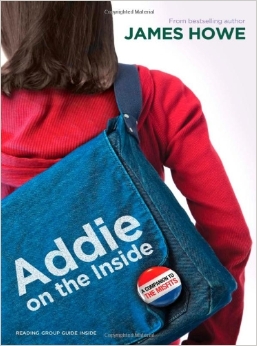
Addie on the Inside by James Howe


Grades 6 and up--

Intended audience: Middle school girls, GLBT tweens.

Audience to whom it will appeal: I think that much of this text could be relatable to boys as well as girls, though the initial interest would be difficult to attain given the cover and title. In order to promote this book to a wider audience, I would post some of the engaging, edgy poems from the book up in the Media Center. I think this book would also be an excellent and enjoyable read for parents or teachers of tweens or teens.
Strengths: Addie on the Inside realistically portrays the inner thoughts and emotions of tweens, both male and female. Addie calls middle school “purgatory…when so many things that never mattered before and will never matter again, matter.” Addie is outspoken, yet self-conscious, happy to be different, but wants badly to fit in; just like most of the middle schoolers I know. The anti-bullying sentiment sends a positive message and gives those wanting to speak up some literary courage. The author also incorporates a fair amount of homages to other YA novels and pop culture references, both of which give the opportunity to make connections outside of the text.
Weaknesses: For those who aren’t fans of poetry, the style of the novel may be a turn-off, although it alternates between free verse and rhyme-scheme poetry. Although I think the thinking, emotions, and experiences of Addie seem to be relatable to both boys and girls, the female voice of the narrator might be less appealing to male readers. The pop culture references are great, but they might be too specific to be accessible to readers in the next few years.
Special considerations: This novel is a companion to an anti-bullying series including The Misfits and Totally Joe that focuses on homophobia and GLBT issues. The books also cite and are supported by GLSEN (Gay Lesbian Straight Education Network). This would be a great book to use with a Gay-Straight Alliance in preparation for the National Day of Silence.
VERDICT: This is a book I would stock multiple copies of and would promote a large or small group reading of it for an anti-bullying group,GSA or even teacher PLC. This is a true middle school book and should grace the shelves of any and all middle school libraries.

Tuesday, March 8, 2016

I Remember Beirut by Zeina Abirached


Grades 6 and up--

This stunning graphic novel is compact, but powerful. The artwork is similar to the stark black and white drawings of Marjane Satrapi’s Persepolis and illustrate the divided world in which she lives: Beirut, Lebanon in the 1980s and 1990s. Written like a list poem, with each page or so beginning with “I Remember,” Abirached tells the story of her life growing up in a war zone.


Intended audience: Young adults interested in history.


Audience to whom it may appeal: I think this book could appeal to upper elementary students to grandparents, of all genders, races and religions. Its universal themes of memory and perseverance through struggle have the potential to provide connections for many.


Strengths: The artwork is visually very appealing. The solid black and white images are simple but captivating. The poetic style and repetition makes it accessible for a wider variety of audiences.


Weaknesses: Without much historical context, this book might be hard to understand, but it can also stand on its own as a story of a young girl’s life and all of the things she experienced. Although the prose and dialogue are relatively simplistic, there are historical and cultural references that will likely be missed by students with little background knowledge.


Special considerations: The book is a companion to A Game for Swallows which focuses on one particular night during war time.

VERDICT: This book would make a great addition to either the graphic novel or history section of any upper elementary through high school media center. The accessible format will appeal to lower readers, while the historical content might entice higher level readers to try a new format: graphic novel.

Monday, February 29, 2016

The Girl Who Could Silence the Wind by Meg Medina


Grades 5 and up--
Rooted in folklore with hints of mystery, magical realism and young love, The Girl Who Could Silence the Wind by Meg Medina tells the story of a small town that believes that one of their own has the power to change their futures, but for her, the pressure has become too much and she has to make a decision to


Intended audience:
According to Medina’s site, she aimed to write a telenovela style story for kids of all ages. I would say more specifically upper elementary students, boys and girls, Spanish speakers.


Audience to whom it may appeal: I think that the novel may appeal to kids and adults alike, those who are interested in a coming of age tale with a few twists and turns. It may also appeal to those interested in learning about magical realism and perhaps those interested in studying the Spanish language.


Strengths: The time and place of the tale is obscure enough that it could be anywhere at anytime which lends it to a unique experience for each and every reader. Its timeless themes of  family, perseverance and love make for a relatable read for all types of readers.


Weaknesses:  While the obscurity of the setting may be enjoyable for readers with strong imaginative skills, some might find the lack of descriptive language hard to picture and follow. There is a sprinkling of Spanish phrases throughout the novel that might discourage readers with no prior knowledge of the language or cultural practices.

VERDICT: An allegory for finding the balance between family and following your heart, this novel would be an excellent addition to an elementary or middle school library for students seeking a story with soul.

Sunday, February 21, 2016

Yaqui Delgado Wants to Kick Your Ass

Grades 7 and up--

Yaqui Delgado Wants to Kick Your Ass is both the title and the first line of this intensely true and moving novel about Piddy Sanchez, her relentless bully and everything else in between.


Intended audience: Middle school and high school students of all races, religions, genders and socioeconomic situations. Note: I feel very confident with these specifics as I heard them from Meg Medina herself at the NCTE conference.


Audience to whom it may appeal: I think this book has the potential to read a vast audience of all people 12 and up. The age old tale of the bully who picks on those smaller and destroys everything in her/his way has been updated for a modern, technological age and this time it’s with girls. I found Piddy’s story to be extremely foreboding, yet brutally honest and accurate to my experience teaching young people.


Strengths: Meg Medina has done her research. The interactions between the characters are so realistic and relatable and the modern references are spot on. The characters are well constructed and interesting and the novel doesn’t resolve itself in a neat little bow, which I found refreshing.


Weaknesses: There were a few sexual references that I found took away from the overall style of the novel, and the prose is more straightforward than poetic, but these were well outweighed by strengths.


Special considerations: This book has great potential as a resource in an anti-bullying program as young as middle school. I think the fact that story revolves around a lower-class Latina, also provides great fodder for discussion about gender and cultural stereotypes.

VERDICT: Yes, your library should have this book. Yes, my library should have this book. Middle school and high school libraries should stock at least 5 copies of this book at any given time. A great opportunity for a small group of kids to read it together or a few teachers to check it out and do it as a read aloud. This is a story that needs to be told and this book is the perfect way to tell it.

Awards and Recognition:

  • 2014 Pura Belpré Award
  • 2014 International Latino Book Award, Best Young Adult Fiction/English
  • 2014 Américas Award Commended Title
  • 2013 Junior Library Guild 2013 Selection
  • 2013 YALSA Best Fiction for Young Adults
  • 2013 Kirkus Best Books for Teens
  • 2013 School Library Journal Best Books

Sunday, February 14, 2016

I'll Give You the Sun by Jandy Nelson

Grades (mature 8th) and up--

To the loners, who feel they can do no right and feel awkward wherever they find themselves: read this book. To the popular kids, who everyone thinks fit in everywhere, but aren't sure themselves: read this book. To the little sister who hates being compared to her older brother and the older brother who wishes he could be as innocent as his younger sister; read this book.

Whoever you are, read this book.

I'll Give You the Sun is the story of Noah and Jude, twins who have always been extremely close but as teenagers suddenly find themselves ripped apart by the secrets they aren't willing to share.

The story goes back and forth between their voices-Noah, who has started to have "left out butter" feelings for the boy next door and is constantly painting in his head, and his sister Jude, the more verbose, wilder, surfer.

 I fell in love with Noah immediately because he shared his "Invisible Museum" of paintings that gave mei nsight no other character was privy to. And then I loved Jude, for her (sometimes unwanted, but always present) protection of her brother and her desire to live her life out loud.

The raw emotion of the characters plus the quirky, yet beautiful writing style of Jandy Nelson that blurs the line between figurative and literal language made me long for the end of the day when I could snuggle up with these characters and hear more of their story.

VERDICT: This book should absolutely grace the shelves (and displays!) of all high school media centers. The characters are relatable, genuine and also realistically flawed.  Given some of the language and sexual references, I would say it would be less appropriate in a middle school setting, but it could be the right fit for the right kid...

Monday, February 1, 2016

Shadowshaper by Daniel Jose Older

Grades 6 and up--

This novel was unlike anything I've read before. It is part realistic fiction, part spirituality narrative, part fantasy, part romance, the list goes on. 
Sierra is an admirable, witty heroine. She talks a mile a minute, paints stunning murals in the city late into the night and has a family secret that she can't quite figure out. For some mysterious reason, her elderly abuelo (grandfather) who hasn't spoken in months starts muttering "lo siento" (I'm sorry) and Sierra wants to know why. Her adventure takes her into a “thrilling collision of artistry and spirituality” (47) that shows young women can be just as powerful as men in any realm. I found myself admiring Sierra for her courage and laughing as she and her friends dealt with every day teenager angst alongside issues of life and death (think Hunger Games or Divergent with a spiritual twist). VERDICT: I think this magical book would make a great addition to any middle or high school media center. It has the power to grab the unsuspecting reader and hold on for the ride, meanwhile exposing him or her to issues worth discussing: race, identity, family, culture, art, heritage, and the power of art to transform relationships.

Tuesday, December 15, 2009

Tangled Threads by Pegi Deitz Shea

Shea, Pegi Deitz. Tangled Threads. Newark: Houghton Mifflin, 2003.

Tangled Threads
is the story of 13-year-old Mai and her experiences from the refugee camps in Thailand through her immigration to the United States. Written in the first person, the story sheds light on the harsh conditions of refugee camps for Hmong and gives a detailed account of the processes necessary for immigration to the U.S. The descriptions Mai gives of her first encounters with transportation, technology and American culture give the reader insight into the potential experience of an immigrant to the United States. The novel focuses on issues of immigration, culture, religion, race, socioeconomic status, belonging, family and survival.

I really enjoyed reading Tangled Threads. Although I didn't find the writing to be particularly excellent, I felt the issues discussed were valuable to a young adult audience. I also appreciated the opportunity to delve deeper into the Hmong culture, of which I have very little prior experience. Given the high population of Hmong people in Minnesota, I think this would be a great text to use with middle school students in the context of cultural competency and coming of age tales.

Monday, October 5, 2009

19 Varieties of Gazelle: Poems of the Middle East by Naomi Shihab Nye


What an incredibly powerful collection! I have never been one to read a book of poetry from cover to cover, but this book kept me engaged throughout each poem like a set of short stories. I was constantly in awe of how much Nye could include in so few words. I felt as if every single poem, practically every single line told a different story.
I think the most pivotal aspect of the poetry was its metacognitive nature: she writes about writing and the power that comes with language. The way she talks about language and communication is incredibly powerful and really made me think about the importance of being able to communicate in one’s native language. This book combines elements of immigration, family, loss, war, peace and the struggle of being torn between two worlds: being an adult vs. being a child, being an American vs. being Arab, speaking English vs. speaking Arabic, living in war vs. living in peace and on and on. She talks about language as a way to express the pain and suffering of living between these two worlds. “The bombs break everyone’s/sentences in half,” she writes, emphasizing the power and violence of cultural destruction (61).
One of the other elements of Nye’s writing that I so enjoyed was her use of personification to emphasize the effect violence has on not only people, but places, things, and relationships. In the poem, “For the 500th Dead Palestinian, Ibtisam Bozieh” she writes about a girl who was killed at an extremely young age: “Dead at 13, for staring through/the window into a gun barrel/which did not know you wanted to be/a doctor” (53). She is treating violence as its own separate entity, a powerful being that can have feelings and emotions, but just chooses not to emit them. In another poem she talks about books and personifies them, but this time gives them emotions: “in Iraq a book never had one owner—it had ten./lucky books, to be held often/and gently, by so many hands/later in American libraries she felt sad/for books no one ever checked out” (110). This is another time in which she emphasizes the power of language and the importance of gaining and sharing knowledge. Following war, she says “certain words, feel impossible in the mouth./Casualty: too casual, it must be changed.” (35)
I really appreciated her focus on children and schools because I feel as though so many adults have written about the Middle East and their experiences, but their writing is not tangible for younger audiences. Nye writes about the experiences in such a way that they become so much more accessible for younger people. She talks about things like school, family and friends with which younger people are more familiar than say, Israeli-Palestinian conflict or strategies of war. For example in one poem she says, “I mighta have been dead too,/for something simple like staring/or shouting what was true/and getting kicked out of school” (53). She really made me think about how much I take my own schooling for granted. I can—and am encouraged!—to say what I think and believe in my classes and I feel safe in my school. Whereas in Nye’s world, “when students gather quietly/inside their own classroom/to celebrate the last day of school,/the door to the building/gets blasted off” (60).
Overall, I felt Nye’s collection was extremely well-written and eye-opening. I don’t know if I would say “enjoyable,” because so many of the poems were so sad, but they were important and that is why I liked this book. In post 9/11 society I think these poems would be a great way to start discussions about the relationship between the U.S. and the Middle East as well as the experience of immigrants in the U.S. Read these poems, but savor them individually, not all at once. Happy reading!