Showing posts with label Young Adult (YA). Show all posts

Friday, June 10, 2016

The Stratford Zoo Midnight Revue Presents: Macbeth by Ian Lendler


Synopsis: As the title implies, this graphic novel is indeed a rendition of Macbeth, as performed by animals. Macbeth is one of Shakespeare’s most famous tragedies about a power hungry man in Denmark who wants to be king and will do almost anything to get the job. This version is no different, except for in place of brutal Shakespearean murder, there is the circle of life (animals eating other animals)...
Intended Audience: Grades 2-5, those interested in graphic novels, animals, and learning about Shakespeare

But it might also appeal to: Middle school students who might better be equipped for the animals eating animals bloody parts, adults and teens who are familiar with the original might enjoy this goofy spoof on Shakespeare’s classic.


Strengths: The illustrations are stunning and the writing makes Shakespeare’s story much easier to understand. For those who understand it, the parody is quite funny as well.


Weaknesses: It is hard to know what this book would be like for someone who hasn’t read (or taught!) Macbeth. Not sure that the story would be as entertaining for those without prior knowledge of the original.


Special considerations: Based on Shakespeare’s Macbeth, some references might be lost on a younger audience, some bloody scenes where animals eat other animals, could be used as a companion text to the original in a high school classroom.


Verdict: The Stratford Zoo’s version of Macbeth would add a new element to any elementary media center: a book about Shakespeare! Given the level of most Shakespearean plays, most students don’t interact with them until high school--or perhaps late middle--but this book allows for an easier access point and introduction to the author. It would also be a great addition to a high school media center where it might be accessed alongside the classic play.


Sunday, April 10, 2016

Lucy Long Ago by Catherine Thimmesh


Grades 4 and up--


Lucy Long Ago tells the story of one of the biggest scientific discoveries of the 20th century: the uncovering of “Lucy”: the “oldest, most complete fossil skeleton ever found.” The book begins with the discovery of the bones in 1974 and traces the scientific research that followed. It is an intriguing combination of science and imagination written in an engaging narrative style.


Intended audience: Elementary or middle school students interested in evolution, science, anthropology or just generally curious about the world we live in.


Audience to whom it may appeal: This book has the potential to engage young and old audience alike with it’s clear explanations, vivid graphics and images and accessible story structure.


Strengths: Though the book is nonfiction, it is written in a narrative style so it has the potential to appeal to a variety of readers as informative as well as entertaining. The pictures and graphics are well done and help the reader to better understand the scientific research that went into Lucy’s discovery and subsequent theories about the history of humanity.


Weaknesses: Some of the science jargon could be a bit off-putting to lower level readers or those with minimal science education. In a way, it might be considered a challenge to creationism, which might bring about requests for removal in certain districts.


Special considerations: This book very much describes science consistent with Darwin (and others’) theory of evolution and could potentially face challenges from parents who prefer their children to focus on their religious teachings of creationism.

VERDICT: I think Lucy Long Ago would make an excellent addition to any elementary, middle or even high school library. Its unique content, vivid graphics and images and narrative style make it a great book for kids of all ages.

Saturday, April 9, 2016

Sex: A Book for Teens by Nikol Hasler


Ages 15 and up--


Intended audience: This book is written for teenagers who are curious about sex, whether or not they are having it or plan to have it.


Audience to whom it may appeal: Although the content may appeal to a younger audience, I think would be difficult to convince a K-8 or younger library to carry this book. It could also appeal to adults who have lingering questions about sex. (I learned a lot!)


Strengths: This book is very straightforward with facts, figures and clear explanations. It is also inclusive of various sexualities and gender identities. The author incorporates humor as well, which could help to alleviate some of the awkwardness of reading such a book.  There are also many resources (websites, phone numbers) for learning more about safe sex including the possibility of STIs and teen pregnancy.


Weaknesses: The cover, style, and content of this book could be construed as giving permission or even promoting teens to have sex. There is also the potential for bits and pieces (chapter titles, cartoons) of the book to be taken out of context and misconstrued. Although the purpose of the book is to inform, I can foresee potential challenges to its forthright (and potentially encouraging) nature.


Special considerations: Clear explanations of sex in all of its variations including GLBT, as well as thorough objective descriptions of the spectrum of gender identities. This may be a book that, although not labeled “reference,” might not wander far from its shelf, though incurring frequent perusal from curious patrons.  

VERDICT: Although the chance of challenge might be high, I would still promote the selection of this book in a high school media center. It is a humorous look at an awkward topic and has the potential to be extremely informative in an area that is often considered taboo. I think that the (mostly) objective explanatory style of the book would be an excellent addition to the library collection.

Monday, April 4, 2016

Between Shades of Gray by Ruta Sepetys


Grades 8 and up--
Although Between Shades of Gray is a narrative capturing the horrors of WWII, it is unlike any other period novel I've ever read. This is the tale of the Baltics under the reign of Stalin, specifically tracing the journey of 15-year-old Lina and her family as they are deported from their home country (Lithuania) and dragged through Siberia into the frozen tundra if the Arctic Circle.

Intended audience: High school students interested in WWII history.

Audience to whom it may appeal: People of all ages, those interested in art, persevering through life's most unbearable struggles, family and history.

Strengths: The novels two biggest doorways are its story--wanting to know the fate of its characters-- and the characters themselves. Sepetys names few characters, Lina's family and three or four others, while the others are given nicknames such as “the bald man” and “the grouchy woman” which allows the reader to truly experience the events of the novel through Lina's eyes.

Weaknesses: The graphic descriptions of the conditions and violence they experience is quite intense and might be a turn-off for some readers. The ending is also quite abrupt and unexpected which might leave readers whose main doorway was characters a bit disappointed.

Special considerations: Prior knowledge of WWII history is critical to a full understanding of the context. Some Russian is used, but most often defined in context.

VERDICT: Due to the graphic nature and violence of the subject matter, this book best fits in a high school media center where students might be better able to contextualize the events of the novel. High school is also often the time during which WII is taught at length in history classes. This book will engage and likely elicit a visceral reaction from thoughtful readers. It is an important book to have on the shelf, not only for its unique perspective on a pivotal moment in history, but for the beauty and strength of its characters.

Tuesday, March 22, 2016

Uprising by Margaret Peterson Haddix


Grades 6 and up--
Uprising by Margaret Peterson Haddix tells the story and events prior to the Triangle Shirtwaist Factory fire of 1911. It tells the story through the lenses of three young women: Yetta, a Russian immigrant who’s passionate about women’s suffrage; Bella, an Italian immigrant, who feels lost without her family close by; and Jane, a girl with means but no real relationships to speak of. The story begins with Yetta and other women in the factory getting the idea to strike against their employers and ends with the fire, the rest you’ll have to find out on your own.
Intended audience: Young people interested in history, likely female, as all of the protagonists are girls.


Audience to whom it may appeal: This book would be an excellent companion text to a historical unit of study, in which case it might appeal to boys and girls if given in context. I also think that this book appeals to adults, male and female. It is not particularly challenging in regard to reading level, but the history significance and the subject has a wide appeal.


Strengths: Three interwoven stories from varying perspectives made for an interesting read, especially those from very different backgrounds. The historical aspects were very accurate from what I’ve researched and the writing is accessible, but not at all dull.


Weaknesses: Some parts move a bit slow and those with little or no knowledge of the women’s suffrage movement might struggle given the lack of context provided. At the end--without giving anything away--there were a few too many plotlines that were wrapped up in a neat little “bow,” which contrasted with the overall style of the novel.


Special considerations: Could be an excellent compliment to a history unit on women’s suffrage or the Triangle Shirtwaist Factory fire. Also promotes open and honest discussion about laborers rights as well as rights for immigrants.

VERDICT: I would absolutely add this to a middle or high school collection for its historical value, its unique style and the way it helps reveal the struggles of immigrants, women, and the working class in a way that is still extremely relevant.

Wednesday, March 16, 2016

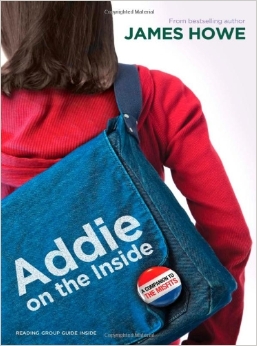
Addie on the Inside by James Howe


Grades 6 and up--

Intended audience: Middle school girls, GLBT tweens.

Audience to whom it will appeal: I think that much of this text could be relatable to boys as well as girls, though the initial interest would be difficult to attain given the cover and title. In order to promote this book to a wider audience, I would post some of the engaging, edgy poems from the book up in the Media Center. I think this book would also be an excellent and enjoyable read for parents or teachers of tweens or teens.
Strengths: Addie on the Inside realistically portrays the inner thoughts and emotions of tweens, both male and female. Addie calls middle school “purgatory…when so many things that never mattered before and will never matter again, matter.” Addie is outspoken, yet self-conscious, happy to be different, but wants badly to fit in; just like most of the middle schoolers I know. The anti-bullying sentiment sends a positive message and gives those wanting to speak up some literary courage. The author also incorporates a fair amount of homages to other YA novels and pop culture references, both of which give the opportunity to make connections outside of the text.
Weaknesses: For those who aren’t fans of poetry, the style of the novel may be a turn-off, although it alternates between free verse and rhyme-scheme poetry. Although I think the thinking, emotions, and experiences of Addie seem to be relatable to both boys and girls, the female voice of the narrator might be less appealing to male readers. The pop culture references are great, but they might be too specific to be accessible to readers in the next few years.
Special considerations: This novel is a companion to an anti-bullying series including The Misfits and Totally Joe that focuses on homophobia and GLBT issues. The books also cite and are supported by GLSEN (Gay Lesbian Straight Education Network). This would be a great book to use with a Gay-Straight Alliance in preparation for the National Day of Silence.
VERDICT: This is a book I would stock multiple copies of and would promote a large or small group reading of it for an anti-bullying group,GSA or even teacher PLC. This is a true middle school book and should grace the shelves of any and all middle school libraries.

Saturday, March 12, 2016

We Were Liars by E. Lockhart


Grades 8 and up--
E. Lockhart’s mysterious coming of age novel begins with Cadence Sinclair Eastman in her seventeenth summer on her family’s private estate, Beechwood Island. The novel bounces back and forth between this summer and “summer fifteen” during which a mysterious accident has happened that she can barely recollect. The book is a series of half remembered moments in her quest to figure out what happened before her accident.


Intended audience: Similar to E. Lockhart’s Printz winning novel The Disreputable History of Frankie Landau-Banks and John Green’s Looking for Alaska, this novel is definitely geared towards a upper-middle-class white high school audience. The setting is a private island near Martha’s Vineyard and its character's cousins who are living off the wealth of their bigoted grandfather.


Audience to whom it may appeal: Although the references often feel a bit highfalutin, the characters still cope with some of the same issues many teens do including: the desire to be autonomous of their parents, wanting to right worldly injustices, and falling in love with the one person their family disapproves of. I think male and female high schoolers of various backgrounds, as well as adults, could find connections, if minimal, in this novel.


Strengths: Given the mysterious nature of Cadence’s accident, I found the book to be a quick read because I wanted to find out what happened. Some strengths of the story include: memorable characters, descriptive setting language, and an engaging plot line with a haunting climax. I also appreciated "the liars'” self-awareness of privilege and their willingness to challenge their grandfather’s bigotry.


Weaknesses: This novel seems geared towards a very specific audience with little invitation for those with varying socioeconomic and racial backgrounds. Knowledge of the privilege lived by those who have experienced “life on the vineyard” seems relatively critical to understanding and enjoying the novel. I imagine this book on a "take a book, leave a book" shelf at the country club I worked at for many summers.

VERDICT: Although the book seems to have a minute intended audience, the mystery of it has the potential to appeal to a wider audience. I would include one copy of this novel in a high school library and promote it as a “haunting mystery about a teenage girl living in a dreamlike state on the fantasy world of her family's private island."

Tuesday, March 8, 2016

I Remember Beirut by Zeina Abirached


Grades 6 and up--

This stunning graphic novel is compact, but powerful. The artwork is similar to the stark black and white drawings of Marjane Satrapi’s Persepolis and illustrate the divided world in which she lives: Beirut, Lebanon in the 1980s and 1990s. Written like a list poem, with each page or so beginning with “I Remember,” Abirached tells the story of her life growing up in a war zone.


Intended audience: Young adults interested in history.


Audience to whom it may appeal: I think this book could appeal to upper elementary students to grandparents, of all genders, races and religions. Its universal themes of memory and perseverance through struggle have the potential to provide connections for many.


Strengths: The artwork is visually very appealing. The solid black and white images are simple but captivating. The poetic style and repetition makes it accessible for a wider variety of audiences.


Weaknesses: Without much historical context, this book might be hard to understand, but it can also stand on its own as a story of a young girl’s life and all of the things she experienced. Although the prose and dialogue are relatively simplistic, there are historical and cultural references that will likely be missed by students with little background knowledge.


Special considerations: The book is a companion to A Game for Swallows which focuses on one particular night during war time.

VERDICT: This book would make a great addition to either the graphic novel or history section of any upper elementary through high school media center. The accessible format will appeal to lower readers, while the historical content might entice higher level readers to try a new format: graphic novel.

Wednesday, March 2, 2016

The Crossover by Kwame Alexander

Grades 5 and up--
Written entirely in rap-style poetry, The Crossover by Kwame Alexander is a quick, enjoyable read. The story follows Josh and Jordan, junior high basketball superstars who also happen to be twins. The poems echo the rhythm of the sport; the book is even divided into four quarters. Along the way, the twins experience the rollercoaster that is adolescence: sibling rivalry, athletics, friendship and what it means to be a family.


Intended audience: Upper elementary and middle school African-American boys, especially those interested in sports, specifically basketball.


Audience to whom it may appeal: This book has the potential to reach a variety of people of all races, male and female, athletes and non-athletes. The unique poetic style of the book would also make for a fun read-aloud for younger students. Young people or adults interested in poetry will be inspired by the distinct writing style that incorporates free verse, slant rhyme, onomatopoeia, and shape poems.


Strengths: Pacing is quick, like adolescents’ attention spans, and its realistic themes of rivalry and relationships will appeal to young adults. The author incorporates high level vocabulary throughout the novel in a creative way that makes it accessible for readers of all levels. Winner of the Coretta Scott King Award and the Newbery Medal.


Weaknesses: Some of the basketball jargon may be lost on those lacking experience with the sport. Sometimes the poetic structure makes the narrative choppy and hard to follow. For dialogue, the author uses italics instead of quotation marks, which might confuse those unfamiliar with that style choice. Very few female characters.

VERDICT: Alexander shoots...and scores! This book deserves a spot in every media center: upper-elementary through high school. Reluctant readers, athletes and poets alike will enjoy this realistic, creative, accessible novel.

Monday, February 29, 2016

The Girl Who Could Silence the Wind by Meg Medina


Grades 5 and up--
Rooted in folklore with hints of mystery, magical realism and young love, The Girl Who Could Silence the Wind by Meg Medina tells the story of a small town that believes that one of their own has the power to change their futures, but for her, the pressure has become too much and she has to make a decision to


Intended audience:
According to Medina’s site, she aimed to write a telenovela style story for kids of all ages. I would say more specifically upper elementary students, boys and girls, Spanish speakers.


Audience to whom it may appeal: I think that the novel may appeal to kids and adults alike, those who are interested in a coming of age tale with a few twists and turns. It may also appeal to those interested in learning about magical realism and perhaps those interested in studying the Spanish language.


Strengths: The time and place of the tale is obscure enough that it could be anywhere at anytime which lends it to a unique experience for each and every reader. Its timeless themes of  family, perseverance and love make for a relatable read for all types of readers.


Weaknesses:  While the obscurity of the setting may be enjoyable for readers with strong imaginative skills, some might find the lack of descriptive language hard to picture and follow. There is a sprinkling of Spanish phrases throughout the novel that might discourage readers with no prior knowledge of the language or cultural practices.

VERDICT: An allegory for finding the balance between family and following your heart, this novel would be an excellent addition to an elementary or middle school library for students seeking a story with soul.

Sunday, February 21, 2016

Yaqui Delgado Wants to Kick Your Ass

Grades 7 and up--

Yaqui Delgado Wants to Kick Your Ass is both the title and the first line of this intensely true and moving novel about Piddy Sanchez, her relentless bully and everything else in between.


Intended audience: Middle school and high school students of all races, religions, genders and socioeconomic situations. Note: I feel very confident with these specifics as I heard them from Meg Medina herself at the NCTE conference.


Audience to whom it may appeal: I think this book has the potential to read a vast audience of all people 12 and up. The age old tale of the bully who picks on those smaller and destroys everything in her/his way has been updated for a modern, technological age and this time it’s with girls. I found Piddy’s story to be extremely foreboding, yet brutally honest and accurate to my experience teaching young people.


Strengths: Meg Medina has done her research. The interactions between the characters are so realistic and relatable and the modern references are spot on. The characters are well constructed and interesting and the novel doesn’t resolve itself in a neat little bow, which I found refreshing.


Weaknesses: There were a few sexual references that I found took away from the overall style of the novel, and the prose is more straightforward than poetic, but these were well outweighed by strengths.


Special considerations: This book has great potential as a resource in an anti-bullying program as young as middle school. I think the fact that story revolves around a lower-class Latina, also provides great fodder for discussion about gender and cultural stereotypes.

VERDICT: Yes, your library should have this book. Yes, my library should have this book. Middle school and high school libraries should stock at least 5 copies of this book at any given time. A great opportunity for a small group of kids to read it together or a few teachers to check it out and do it as a read aloud. This is a story that needs to be told and this book is the perfect way to tell it.

Awards and Recognition:

  • 2014 Pura Belpré Award
  • 2014 International Latino Book Award, Best Young Adult Fiction/English
  • 2014 Américas Award Commended Title
  • 2013 Junior Library Guild 2013 Selection
  • 2013 YALSA Best Fiction for Young Adults
  • 2013 Kirkus Best Books for Teens
  • 2013 School Library Journal Best Books

Me and Earl and the Dying Girl by Jesse Andrews

Grades 9 and up--

Me and Earl and the Dying Girl by Jesse Andrews tells the story of Greg an amateur film maker who is stuck (yes, that’s how he describes it) making frequent hospital visits to girl from his school who’s recently been diagnosed with leukemia. Witty and awkwardly funny in many parts, crude and inexplicable in others, I’m still working out my emotional response to this book.


Intended audience: Being that this has got to be one of the strangest books i’ve ever experienced (it was definitely more than a read, it was an experience), I am not 100% sure I know the audience for whom it was intended, but I think high school boys. Girls may have been considered, but definitely not as the core audience.
Audience to whom it may appeal: I can see this book appealing to both high school age boys and girls, and perhaps also the 18-25 range for young men. Though this might be stereotypical (okay, it’s flat out stereotypical), I found a lot of the humor quite crude and a bit offensive and feel other females might have a similar reaction.
Strengths: The unique structure of the book as a film script makes for a quick and interesting read. It is also written in the second person, where the narrator speaks directly to the reader, which has an odd effect. I liked that it was different than many YA novels I’ve read in that regard.
Weaknesses: Like I mentioned previously, the crude humor could be taken down a notch for a more universal readership, and the young narrator is extremely self-deprecating throughout the entire book, which I believe sends a negative message to young creative minds. There is also quite a bit of potty humor and a plethora of curse words with no limit on F-bombs.


Special considerations: This book was made into a movie, which I have yet to review.

VERDICT: I think the unique format of the book and the fact that it has been made into a movie, make this a book with few competitors in its vein. That said, I think a single copy of this book would suffice in a high school library. Though it might offend the first few who page through it, given the right student, a real connection could be made. And that’s the ultimate goal, right?