Showing posts with label Social Justice Issues. Show all posts

Friday, June 10, 2016

Red: A Crayon's Story by Michael Hall

Synopsis: Spoiler alert! “Red” is a blue crayon with a red label. Everyone expects him to be great at drawing things like hearts and strawberries, but he keeps failing until a new friend asks him to do the unexpected....


Intended Audience: Pre K - grade 2


But it might also appeal to: Younger kids might enjoy as a read aloud, could be a good book for discussing identity and expectations with middle grade or YA readers.


Strengths: Sends a positive message about being true to yourself, colorful illustrations that look quite similar to typical crayon drawings and could be and exciting familiar feature for young readers. Demonstrates a healthy range of emotions for children (and crayons!).


Weaknesses: The text is quite small to leave room for the illustrations, but might be intimidating for new readers.


Special considerations: Although the basic message is about identity in general, this book could be used as a tool for teaching children about gender identity.


Verdict: Red tells a great story about getting to know yourself, a message that everyone can benefit from and should be available to be “red” by all audiences pre-k to adult.


Thursday, June 9, 2016

Morris Micklewhite and the Tangerine Dress by Christina Baldacchino, Illustrated by Isabelle Malenfant


Synopsis: Morris Micklewhite loves to play dress-up, especially if it means he can wear the tangerine dress in his classroom’s dress up chest. Unfortunately, the other kids don’t think it is okay for a boy to wear a dress, so his classmates pick on him. One day he decides to stay home because he is feeling bad about himself, but learns something very important about the tangerine dress...and himself.


Intended Audience: Pre-k to grade 2


But it might also appeal to: Upper elementary students, even middle school students when talking about identity and having courage to be different from your peers


Weaknesses: Although the book encourages Morris’ choice to wear the dress and be different, the fact that he was essentially being bullied by his classmates is never explicitly brought up and the fact that the positive message comes when he skips school for a day might be a bit confusing for kids.


Strengths: The illustrations are stunning and the story sends a positive message about being unique and also a more subtle message about how sometimes gender norms restrict kids’ ability to express themselves.


Special considerations: Although subtle, the message about gender norms could provide for an interesting parent-child or teacher-child conversation about how toys and clothes are chosen for kids of different genders.


Verdict: Any book that promotes creativity and imaginative play in the same way as Morris Micklewhite absolutely deserves a place on the shelf of a media center for kids of all ages. I would even argue a high school media center could benefit from its presence.

Wednesday, March 16, 2016

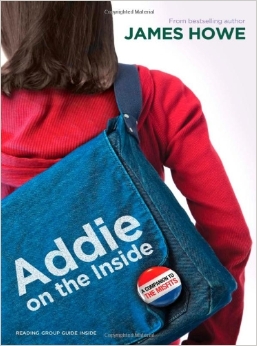
Addie on the Inside by James Howe


Grades 6 and up--

Intended audience: Middle school girls, GLBT tweens.

Audience to whom it will appeal: I think that much of this text could be relatable to boys as well as girls, though the initial interest would be difficult to attain given the cover and title. In order to promote this book to a wider audience, I would post some of the engaging, edgy poems from the book up in the Media Center. I think this book would also be an excellent and enjoyable read for parents or teachers of tweens or teens.
Strengths: Addie on the Inside realistically portrays the inner thoughts and emotions of tweens, both male and female. Addie calls middle school “purgatory…when so many things that never mattered before and will never matter again, matter.” Addie is outspoken, yet self-conscious, happy to be different, but wants badly to fit in; just like most of the middle schoolers I know. The anti-bullying sentiment sends a positive message and gives those wanting to speak up some literary courage. The author also incorporates a fair amount of homages to other YA novels and pop culture references, both of which give the opportunity to make connections outside of the text.
Weaknesses: For those who aren’t fans of poetry, the style of the novel may be a turn-off, although it alternates between free verse and rhyme-scheme poetry. Although I think the thinking, emotions, and experiences of Addie seem to be relatable to both boys and girls, the female voice of the narrator might be less appealing to male readers. The pop culture references are great, but they might be too specific to be accessible to readers in the next few years.
Special considerations: This novel is a companion to an anti-bullying series including The Misfits and Totally Joe that focuses on homophobia and GLBT issues. The books also cite and are supported by GLSEN (Gay Lesbian Straight Education Network). This would be a great book to use with a Gay-Straight Alliance in preparation for the National Day of Silence.
VERDICT: This is a book I would stock multiple copies of and would promote a large or small group reading of it for an anti-bullying group,GSA or even teacher PLC. This is a true middle school book and should grace the shelves of any and all middle school libraries.

Sunday, February 21, 2016

Yaqui Delgado Wants to Kick Your Ass

Grades 7 and up--

Yaqui Delgado Wants to Kick Your Ass is both the title and the first line of this intensely true and moving novel about Piddy Sanchez, her relentless bully and everything else in between.


Intended audience: Middle school and high school students of all races, religions, genders and socioeconomic situations. Note: I feel very confident with these specifics as I heard them from Meg Medina herself at the NCTE conference.


Audience to whom it may appeal: I think this book has the potential to read a vast audience of all people 12 and up. The age old tale of the bully who picks on those smaller and destroys everything in her/his way has been updated for a modern, technological age and this time it’s with girls. I found Piddy’s story to be extremely foreboding, yet brutally honest and accurate to my experience teaching young people.


Strengths: Meg Medina has done her research. The interactions between the characters are so realistic and relatable and the modern references are spot on. The characters are well constructed and interesting and the novel doesn’t resolve itself in a neat little bow, which I found refreshing.


Weaknesses: There were a few sexual references that I found took away from the overall style of the novel, and the prose is more straightforward than poetic, but these were well outweighed by strengths.


Special considerations: This book has great potential as a resource in an anti-bullying program as young as middle school. I think the fact that story revolves around a lower-class Latina, also provides great fodder for discussion about gender and cultural stereotypes.

VERDICT: Yes, your library should have this book. Yes, my library should have this book. Middle school and high school libraries should stock at least 5 copies of this book at any given time. A great opportunity for a small group of kids to read it together or a few teachers to check it out and do it as a read aloud. This is a story that needs to be told and this book is the perfect way to tell it.

Awards and Recognition:

  • 2014 Pura Belpré Award
  • 2014 International Latino Book Award, Best Young Adult Fiction/English
  • 2014 Américas Award Commended Title
  • 2013 Junior Library Guild 2013 Selection
  • 2013 YALSA Best Fiction for Young Adults
  • 2013 Kirkus Best Books for Teens
  • 2013 School Library Journal Best Books

Monday, February 1, 2016

All American Boys by Jason Reynolds and Brendan Kiely

Grades 7 and up--

As cliche as "ripped from the headlines" sounds, this book is just that. And it is excellent. I cannot say enough positive things about this novel. The story of a brutal interaction between a police officer and a teenager is told through the eyes of two boys: one black, one white. One is a witness, the other a victim. I couldn't take myself away from this book. It followed me for weeks after I put it down in the same way news of similar stories has haunted us in recent years. I do not want to give too much away, but I think this fictionalized version of an all-too-familiar tale is absolutely worth the time, teens and adults alike.

Although the intended audience may be teenagers, I think this book could appeal to a variety of individuals young and old, teens and those who parent or work with them. The strength of the book comes in its rawness and realistic portrayal of recent events. It also shows multiple perspectives which is crucial for addressing such a difficult issue. The only weakness I noticed was the lack of female characters, but this issue does more often affect young males, so it is understandable that they played smaller roles.

VERDICT: This book is a must-have for all middle (7+) and high schools. Its relevance and quality create that rare book that has the potential to build bridges.

Awards: Coretta Scott King, 2016

Tuesday, December 1, 2009

American Born Chinese by Gene Luen Yang


-->
From the moment I picked up American Born Chinese, I was excited to read it cover to cover. I had paged through the novel looking at the pictures and reading the inside flaps, but I couldn’t wait to dive into the story itself. I knew that the book was divided into three parts and going into the book, I was most excited to read about the story of Jin Wang: the partially autobiographical, realistic fiction portion of the novel. I was hesitant to read what appeared to be a folktale and a blatantly racist representation of a Chinese individual. However, I was determined to give the other two parts a fair shot and I was pleasantly surprised.
Although I taught my intersession course on comics and graphic novels, I remain to have very minimal experience with visual texts. At first, I will admit, I thought that reading graphic novels was a little like cheating. How was I supposed to “use my imagination” if the pictures were already there? Where was the challenge? However, teaching my intersession class and reading this novel really helped me to understand the unique role of the graphic novel. Yang was able to represent so much more of his message with pictures that would have been impossible or just plain confusing if written out in language. Given that the story is all about identity and the diversity of cultures, it seemed fitting that he use a medium that is universal: pictures. And the way they have been so beautifully drawn, no translation is needed whatsoever.
The story thread of the Monkey King was really interesting to me. Having no familiarity with Chinese folktales, it made me want to learn more. I felt this element of the story showed the pride Yang has in his heritage while the other two showed the difficulty he had with combining his heritage with his newfound culture; a challenge for so many adolescents (and adults) today. Now that I have read this novel and seen one version of the monkey king tale, I plan on reading more about the Chinese folktale.
At first I was completely shocked at Yang’s blunt use of racial stereotyping in the character of Chin-kee. I thought to myself, “how could someone who is promoting pride in his heritage be so blatantly racist in his portrayal of his own culture?” However, it didn’t take long to realize Yang’s purpose: blatant stereotyping would stand out and make readers think. Yang is aware that this language is used to describe and mock Chinese people on a regular basis and he wants his readers to see what this looks and feels like. It is extremely offensive and I truly believe that was Yang’s intent. It really made me think about the stereotypes I see and hear on a regular basis and what I might do to contradict those racist actions. I really appreciated his bold choice to use a stereotypical character to get his ideas across.
As far as the medium goes, I feel that a graphic novel was a great choice for this particular trio of stories. Yang was able to easily shift from story to story with a simple shift of background. His ability to use visual cues to illustrate emotion and inner thoughts really helped me to understand the characters on an entirely different level. In a way, the increase in visual cues allowed me to have a deeper comprehension of the story as well as the changes each of the characters experiences throughout the novel.
Overall, I really enjoyed the book. Yang is an incredible storyteller through images and ideas and I am grateful he was willing to put his thoughts and feelings on paper so that others might begin to understand his experience. I would highly recommend this book, particularly to someone who has little or no experience with graphic novels. Happy reading!

Saturday, November 28, 2009

Sold by Patricia McCormick


Lakshmi is a 13-year-old girl living in Nepal with her mother and stepfather. When her stepfather gambles away the family’s income, Lakshmi must take a job in the city as a maid. Dozens of cities and strange tour guides later, Lakshmi realizes the maid job was a cover: she is in India and has been sold into sexual slavery, with little hope of ever returning home. Written in short vignette style chapters, this novel tells the heartbreaking story of a young girl attempting to survive with only the memory of happiness to keep her afloat.

This book continues to give me chills. It is sad, disturbing, and horrifyingly true. My heart is completely broken for these young girls who live everyday not knowing if they will ever see their families again who experience the violation of their innocence on a regular basis. Written with incredible care and seemingly impossible lyricism, this novel is a much needed dose of reality. Although undeniably harsh, the story McCormick tells is one that cannot be ignored and is an important novel for teen and adult readers alike.

Luna by Julie Ann Peters


For this book blog, I have chosen to write my response in the form of a letter to the author. I had an extremely positive reaction to this text and I wanted to frame my response in the form of a thank you to Julie Ann Peters, an author who I believe has taken an incredible leap and landed with grace. I fully intend on mailing an edited version of this letter upon reception of feedback.

Ms. Peters,
Thank you. You have captured the experience of a transsexual teen with such honesty, intelligence, and heart. Your novel, Luna was a joy to read for a plethora of reasons.
First of all, you gave your characters honest, realistic thoughts and feelings. You did not sugarcoat the incredibly challenging and heartbreaking discussion or experiences that accompany coming out as a trans individual and I think this truly made your book incredible. “She loved hearing that, that she could pass. Most girls spend hours and hours working on themselves so they’ll be striking, eye-catching, desirable. Liam would give everything to live one day as a plain, ordinary girl” (54). This passage really resonated with me. I have had so many similar conversations with my trans friends who have said those very same words and each and every time it breaks my heart. You have crafted this experience with precision and truth.
I was also very impressed with your seamless interweaving of the construction of gender and gender roles within the pages of the text. This allows your reader to place him or herself within the story, even if he or she does not have personal experience with a trans individual. The passage in which Regan is describing her babysitting charges was particularly accurate and succinct: “Pretty. A word for girls. The way handsome described boys. Liam was right; people did use boy and girl language. They expected different behaviors. When kids acted ‘out of role,’ as Liam put it, they were labeled tomboys or sissies” (50). Your mention of sexuality as a spectrum is also very enlightened; a bold yet important choice for a young adult novel.
Although your novel deals with issues of transsexuality, you take special care to not lump the T in with the G, L and B. This is often a challenge and I thought you did an excellent job of separating these identities and describing them respectfully and accurately. As you know, even people who have friends or relatives who identify as G, L, B or T still do not understand the difference between them. This particular inner monologue of Regan really stuck out for me: “He likes guys. We both do. That doesn’t make him gay. It makes him as straight as me because in side he’s a girl, Dad. Just like me. You have two daughters, okay?” (123). The separation of sexuality and gender from one another in your novel is very clear-cut in a way that I think young adults can really “get.” These distinctions and definitions are important and wonderfully effective when voiced by a likeable character in a novel.
In addition, I really admired your decision to give the voice of the novel to Regan rather than her transsexual sibling. Oftentimes coming of age stories are written from the perspective of the individual going through the identity discovery/crisis themselves. I thought having Regan tell the story was the perfect way to construct this narrative. This allows the book to reflect multiple perspectives, not just that of the trans individual. With Regan as narrator, the reader can get a sense of what it might be like to support a friend or family member going through something similar. It is a unique challenge that is not often discussed. I really appreciate the way you portrayed Regan. She was incredibly supportive, but also struggling and learning—a very honest depiction to which your readers can relate.
Overall, I thought your novel was incredibly well crafted, a very possible story with realistic issues and characters. Your willingness to write about a topic that many consider controversial is commendable. Thank you for creating a story in which even the most silenced voices can be heard. I cannot wait to share this story with my future students.
Sincerely,
Sarah Rose

La Linea by Ann Jaramillo

La Línea is the story of 15-year-old Miguel’s journey from Mexico to the United States. Miguel has been looking forward to crossing the border (la línea) for six years, eleven months and twelve days, since his parents left he and his sister, 13-year-old Elena, with their grandmother in Mexico. The siblings encounter many trials along their journey including train gangs, thieves, life-threatening exhaustion and living in constant fear of la migra. The story is incredible tribute to the power of family, resilience, and the incredible challenge (and importance) of overcoming obstacles.
La Línea is a fascinating, exciting and important text for students and teachers alike. Bringing together issues of belonging and immigration in a fast-paced adventure, Jaramillo has written a great young adult novel. Having little to no experience with immigration, this book was extremely enlightening for me. I am in awe at the lengths people are willing to go to immigrate to America and it made me aware of the things I previously took for granted. I think this is an important lesson for everyone and Jaramillo expresses it in a very well written, engaging story.

Monday, November 23, 2009

A Long Way Gone by Ishmael Beah

Talk about a visceral reaction. This book was incredibly terrifying. But, I’m glad I read it because there is no cure for ignorance besides education. A Long Way Gone is an amazing example of a text that promotes social change in an extremely powerful way. There is no way that a documentary on child soldiers or a newspaper article could have the power this book has. Seeing war through the innocent eyes of a child is the most authentic, honest portrayal of war there is. The most powerful aspect of the text was the changes Ishmael experiences throughout the book. It is awful to watch him be stripped of his innocence one page at a time. At the beginning, we see him responding as a civilian: “I turned away, and my eyes caught the smashed head of another man…I felt nauseated. Everything began to spin around me. One of the soldiers was looking at me, chewing something and smiling. He took a drink…‘You will get used to it, everybody does eventually,’ he said” (100). At that point in the text, I too felt sick to my stomach and I remember thinking “there is no way he will get used to this.”

However, we see the power brainwashing and propaganda can have on someone who has lost all hope. During training, the soldiers are reminded of their loss and coerced into allegiance with the government: “Visualize the enemy, the rebels who killed your parents, your family, and those who are responsible for everything that has happened” (112). Their leaders tell them, “Our job is a serious one and we have the most capable soldiers, who will do anything to defend this country” (123).
It was absolutely horrifying watching Ishmael fall into these (what I thought to be obvious) traps. It makes sense that he had to distance himself from his actions and be almost empty, similar to an abuse victim: “I just sat with my head in my hands, thoughtless” (109).

For a good part of the book, I must admit I was angry with Ishmael. I did not understand how he could transform so quickly from an innocent child into a soulless killer. However, I pushed through and knew deep down that what I really felt was remorse and sadness for his loss of innocence. He was truly a victim. This is absolutely devastating. This particular passage sticks out in my head: “I didn’t feel a thing for him, didn’t think that much about what I was doing. I just waited for the corporal’s order. The prisoner was simply another rebel who was responsible for the death of my family, as I had come to truly believe” (124). In hindsight, Ishmael is realizing that he had created excuses for himself and pointed out his reasoning for completing such terrible acts. The fact that I know he was a victim of a horrible crime does not eliminate the goose bumps from the back of my neck as a re-read this passage.
Horrifying memories reenacted aside, this book was extremely powerful for me. Having little to no knowledge of the situation in Sierra Leone, this book gave me a very personal account of the horrors that occurred there during the civil war.

And last but not least, I was so incredibly grateful for Esther, Ishmael’s nurse. She showed an incredible amount of compassion for Ishmael and was willing to step completely outside of her comfort zone in order to help him. She helped him to begin his lengthy but crucial recovery in a very powerful way. I would highly recommend this book to anyone, young or old, for it teaches an amazing lesson about the resilience of the human spirit. Happy reading!

Friday, November 6, 2009

The House of the Scorpion by Nancy Farmer


This book made me cringe. And cry. And laugh. And want to scream. And that, to me, is the sign of an excellent book. Farmer’s frighteningly possible imaginary story is an incredible creation. From the setting of Opium/Dreamland to the concept of mindless “eejits,” Farmer has done an excellent job of taking science to an entirely new eye-opening, bone-chilling level. I am always hesitant to read science fiction because I feel more inclined to read books that I find particularly relevant to my own life. However, after reading The House of the Scorpion, I have a newly found appreciation for the genre. Like Orwell’s 1984, Farmer’s novel forces us to face the things we are most afraid of—and makes them very realistic. Given the current state of science in our society it is not unlikely that cloning could become a part the world as we know it. All the issues Farmer broaches—cloning, illegal drug empires, dictatorships, exaggerated versions of Communism, and brain washing—make for an incredibly dense and intense novel. To top it off, she gives us a main character with a less-than-desirable identity who is going through the pains of puberty while trying to save his own life!
From the second I opened the book to the last sentence, I found myself cheering for Matt. He is an incredibly realistic teenage boy. He is simultaneously trying to find his identity, build his self-esteem, and attempt a romantic relationship, all while undermining and admiring authority figures. He is the ultimate underdog in the story and it is for that reason that he is so likeable. Not only did Farmer draw me in with the rapidly paced plot, but her vivid descriptions of the smells and sights of Opium and the treatment of the “eejits” elicited an unpleasant visceral reaction that erupted from my gut.
“The evil smell made Matt’s eyes water, and he could barely focus on the dense yellow sludge on the bottom…he threw himself off the horse and sucked desperately at the inhaler. His lungs filled with liquid. A terror of drowning swept over him, and he tried to crawl away from the trough. His fingers dug into the rotting fish-slimed oil” (172).

I really enjoyed this book because it made me think. It made me question the role of government and the issues surrounding cloning and drug wars. Is cloning moral? What is the goal of stem-cell research? Should the government play a role in science? To what extent?
It also helped me to realize that the issues teenagers deal with—dating, relationships, identity, culture, appearance, belonging, family, work, play, and so on, are completely timeless and have and will continue to affect teenagers in any era. She also does a wonderful job of showing the reader how Matt grows throughout the story. She does this explicitly by labeling the sections “Youth”, “Middle Age”, “Old Age”, “Age 14” and “La Vida Nueva,” but she also does this implicitly by slightly altering his language and endowing him with more mature thought processes as the story unfolds. At one point towards the end of the novel, Matt has begun to realize the possibility of escape. One such inner monologue follows:
“Matt felt light-headed. This meant that every single night the Keepers turned into zombies. This meant the factory was left unguarded. The power plant that electrified the fence was left unguarded. A big sign flashing FREEDOM lit up in Matt’s mind” (309).

I also appreciated the mixture of English and Spanish phrases and the incorporation of Mexican folklore into the text. This was also an excellent way to demonstrate the timelessness of cultural beliefs, language and lore.
If Farmer’s novel can intrigue an unwilling reader, I have no doubt it will be a perspective-altering read for anyone interested enough to dive into this novel.

Monday, October 5, 2009

19 Varieties of Gazelle: Poems of the Middle East by Naomi Shihab Nye


What an incredibly powerful collection! I have never been one to read a book of poetry from cover to cover, but this book kept me engaged throughout each poem like a set of short stories. I was constantly in awe of how much Nye could include in so few words. I felt as if every single poem, practically every single line told a different story.
I think the most pivotal aspect of the poetry was its metacognitive nature: she writes about writing and the power that comes with language. The way she talks about language and communication is incredibly powerful and really made me think about the importance of being able to communicate in one’s native language. This book combines elements of immigration, family, loss, war, peace and the struggle of being torn between two worlds: being an adult vs. being a child, being an American vs. being Arab, speaking English vs. speaking Arabic, living in war vs. living in peace and on and on. She talks about language as a way to express the pain and suffering of living between these two worlds. “The bombs break everyone’s/sentences in half,” she writes, emphasizing the power and violence of cultural destruction (61).
One of the other elements of Nye’s writing that I so enjoyed was her use of personification to emphasize the effect violence has on not only people, but places, things, and relationships. In the poem, “For the 500th Dead Palestinian, Ibtisam Bozieh” she writes about a girl who was killed at an extremely young age: “Dead at 13, for staring through/the window into a gun barrel/which did not know you wanted to be/a doctor” (53). She is treating violence as its own separate entity, a powerful being that can have feelings and emotions, but just chooses not to emit them. In another poem she talks about books and personifies them, but this time gives them emotions: “in Iraq a book never had one owner—it had ten./lucky books, to be held often/and gently, by so many hands/later in American libraries she felt sad/for books no one ever checked out” (110). This is another time in which she emphasizes the power of language and the importance of gaining and sharing knowledge. Following war, she says “certain words, feel impossible in the mouth./Casualty: too casual, it must be changed.” (35)
I really appreciated her focus on children and schools because I feel as though so many adults have written about the Middle East and their experiences, but their writing is not tangible for younger audiences. Nye writes about the experiences in such a way that they become so much more accessible for younger people. She talks about things like school, family and friends with which younger people are more familiar than say, Israeli-Palestinian conflict or strategies of war. For example in one poem she says, “I mighta have been dead too,/for something simple like staring/or shouting what was true/and getting kicked out of school” (53). She really made me think about how much I take my own schooling for granted. I can—and am encouraged!—to say what I think and believe in my classes and I feel safe in my school. Whereas in Nye’s world, “when students gather quietly/inside their own classroom/to celebrate the last day of school,/the door to the building/gets blasted off” (60).
Overall, I felt Nye’s collection was extremely well-written and eye-opening. I don’t know if I would say “enjoyable,” because so many of the poems were so sad, but they were important and that is why I liked this book. In post 9/11 society I think these poems would be a great way to start discussions about the relationship between the U.S. and the Middle East as well as the experience of immigrants in the U.S. Read these poems, but savor them individually, not all at once. Happy reading!

Monday, September 28, 2009

She Would Draw Flowers: A Book of Poems by Kirsten Savitri Bergh


This book of poetry is so incredibly heart wrenching and powerful. The book is comprised of poetry and drawings from the journals of Kirsten Savitri Bergh published by her mother after she passed away in a car accident at the age of 17. She and her family were from Minneapolis and she attended the Minnesota Waldorf school. The writing is absolutely beautiful and her language is well beyond her years. Because the poems weren't written necessarily to be published, the poetry is just that much more raw and emotional. You can really tell what an amazing, articulate and artistic person she was. She writes about everything from something as mundane as lime jello to the passing of her father when she was 16. She was also a student abroad in France and some of her poetry includes elements of French. This is also a wonderful example of the ways free verse poetry can be just as affective as any rhyme scheme. She not only writes from her own perspective but from many others--a practice which I think all poets should exercise. She even includes an Ars Poetica (poem about the process of writing poetry) called "Beginning Barefoot." I would HIGHLY recommend this book for anyone who is interested in poetry or someone who wants to try poetry but is intimidated: this is a great entry to poetry and it is by a young person. So inspiring!

Kirsten's mom, Linda provides more information about Kirsten on this wonderful website. Happy reading (and surfing!)

Wednesday, September 23, 2009

Looking for Alaska by John Green

John Green's novel about 15 year-old Miles' experiences at an Alabama boarding school is an incredible read. The first person narrative takes the reader into a world that not many teenagers have the opportunity to experience: independent living where friends serve as family and school is life. Miles speaks so genuinely and his interactions with his friends are so realistic that you feel as though you are there. I have seen John Green speak and to be honest I was worried that he could only be funny in person, but I was pleasantly surprised by his hilarious writing. Who would have thought that rapping in a novel could actually be effective? (even more so if you are willing to read those parts aloud!)
One of my favorite elements of this book is that Miles has friends, teachers, and family members from all walks of life--the same as any reader likely would. And these characters are dealing with big important issues that other authors might shy away from, but Green attacks them head on and does it extremely well. As a writer he has a keen appreciation of what these kids can handle and doesn't sugarcoat issues like death, drugs, alcohol, sex, and relationships. He sees adolescence for what it truly is: a confusing, exhilarating, eye-opening, stressful, enjoyable, roller coaster of a ride. He gets it. And that is what makes this book so awesome.
The book's title character, Alaska Young, can really only be described as a charming whirlwind of a human. Feisty, feminist and flirty she draws in not only the protagonist but the reader as well. The title of the novel is quite accurate, as a large percent of Miles' time is spent trying to delve a little deeper into what makes this mysterious girl tick.
Not only are Green's characters intriguing, but they are not flat. Each of them has a background, a struggle and a multi-faceted personality. They are not just names on a page. Take for instance, the protagonist, Miles. Like all of his classmates, he is quirky, and his particular idiosyncrasy is that he studies and remembers "last words." This adds an element of darkness to the novel, but in a way that is seen as lighthearted and eccentric.
Miles, or 'Pudge' as he has been ironically dubbed (he more closely resembles a string bean than anything remotely 'pudgey') has a very tight relationship with his roommate Chip or the Colonel. This is also a bold move on Green's part that I applaud. It is not often that we as readers see the interworkings of male-male friendships and it is really refreshing to see them talk to each other, rely on each other and support each other in similar ways to female-female friendships or male-female friendships.
I wholeheartedly recommend this book to YOU. Whoever you are...for while you are "looking for Alaska" you will undoubtedly find out something more about yourself.
Happy reading!

Monday, September 21, 2009

The Absolutely True Diary of a Part-Time Indian by Sherman Alexie


-->
I absolutely, truly enjoyed this book. Alexie's partly autobiographical novel that relays the experiences of a teenage boy is so genuine and honest it is impossible to dislike.
The first-person style of the book makes it easy to dive into the reading. You really do feel as though you are reading someone’s journal and it makes you feel that much closer to the main character, Arnold or “Junior” Spirit. You know a book has been written well when you feel as though you know the characters well enough to care about what happens to them. And Arnold is hilarious. You will laugh out loud at least once.
Additionally, I will always enjoy a book that includes cartoons because sometimes words cannot express every feeling we are trying to evoke. Arnold’s drawings make this book much more real because I can relate to it. We all doodle and draw and make diagrams in order to express things more fully. It was wonderful to see an author do the same. Arnold explains his reason for drawing pictures: “when you draw a picture, everybody can understand it. If I draw a cartoon of a flower, then every man, woman, and child in the world can look at it and say, ‘That’s a flower’” (5).
Not only is the book genuine, candid, funny, and artistic, but it is also open minded. The book brings up issues of race, sexuality, culture, group association, family structures, alcohol use and abuse, legacy and self-fulfilling prophecies, and relationships. By deciding to leave the rez for school, Arnold has made the decision to grow up extremely fast and is not afraid to talk about how scary and overwhelming this can be. Arnold understands the challenge he is facing and knows what kind of ridicule he will face, but HE DOES IT ANYWAY. This is so courageous. I found myself asking, “Would I have the guts to do this? How would I react if my family and friends were harassing me for following my heart? Would I be able to stand the (metaphorical and literal) ‘boos’?” He is conscious of the weightiness of his decision. One of the questions he asks that I might pose to my students (and colleagues!) is: “Should a teenager be worried about his fricking legacy anyway?”
The race issues addressed in this book include very specific references to White teachers teaching at the all Indian school on the reservation. This is extremely powerful because it is the first time that Arnold is exposed to the racist nature of the reservation and is (rightfully) outraged by it. This conversation ultimately leads to his decision to leave the rez and attend school elsewhere. Difficult topics like this are what makes this book so important and memorable.
This is an important, enjoyable, honest read that I would recommend for any reader. The insight Alexie gives the reader is incredible and eye-opening. This book poses though-provoking, discussion-creating questions that I think everyone should be exposed to. This book allows its reader to begin to formulate an understanding of the meaning of belonging…something to which we can all easily relate. Happy reading!