Showing posts with label Series. Show all posts

Saturday, June 11, 2016

Minn and Jake's Almost Terrible Summer by Janet S. Wong, Illustrated by Genevieve Cote


Synopsis: The second in the Minn and Jake series, this free-verse novel follows the friends into summer - a summer apart! Jake is visiting old friends and family in California, while Minn is all the way across the country! How are they supposed to be best friends when they can’t chase lizards together? Luckily, before things get too bad, Jake finds out Minn is coming to visit and everything seems great, until they go to Disneyworld and the happiest place on earth suddenly isn't...

Intended Audience: Boys and girls grades 3-5, likely those who have read the original Minn and Jake.


But it might also appeal to: Younger students as a read-aloud, or middle schoolers trying to forge friendships across that ever-frightening gender boundary.


Strengths: The style of the book - in verse - makes it accessible to newer readers and the images add a great deal of fun to the story. The message that friendship sometimes requires apologies is an important one for upper elementary and middle school students has they begin to have relationships outside of their families.


Weaknesses: Given that the novel is written in free verse, the author makes different style choices that readers of prose novels might not be used to: for example using italics instead of quotation marks to show who is speaking.


Special considerations: This is a companion to Minn and Jake. Not knowing the history of the friends made starting this one a big challenging, so it might be best to read this after the original!


Verdict: If the media center already has Minn and Jake, this would be an excellent addition as well -- its positive message about friendship, especially those between boys and girls, is valuable to kids of all ages! Wong’s unique style of free verse would also add to the diversity of any collection.


Friday, June 10, 2016

The Stratford Zoo Midnight Revue Presents: Macbeth by Ian Lendler


Synopsis: As the title implies, this graphic novel is indeed a rendition of Macbeth, as performed by animals. Macbeth is one of Shakespeare’s most famous tragedies about a power hungry man in Denmark who wants to be king and will do almost anything to get the job. This version is no different, except for in place of brutal Shakespearean murder, there is the circle of life (animals eating other animals)...
Intended Audience: Grades 2-5, those interested in graphic novels, animals, and learning about Shakespeare

But it might also appeal to: Middle school students who might better be equipped for the animals eating animals bloody parts, adults and teens who are familiar with the original might enjoy this goofy spoof on Shakespeare’s classic.


Strengths: The illustrations are stunning and the writing makes Shakespeare’s story much easier to understand. For those who understand it, the parody is quite funny as well.


Weaknesses: It is hard to know what this book would be like for someone who hasn’t read (or taught!) Macbeth. Not sure that the story would be as entertaining for those without prior knowledge of the original.


Special considerations: Based on Shakespeare’s Macbeth, some references might be lost on a younger audience, some bloody scenes where animals eat other animals, could be used as a companion text to the original in a high school classroom.


Verdict: The Stratford Zoo’s version of Macbeth would add a new element to any elementary media center: a book about Shakespeare! Given the level of most Shakespearean plays, most students don’t interact with them until high school--or perhaps late middle--but this book allows for an easier access point and introduction to the author. It would also be a great addition to a high school media center where it might be accessed alongside the classic play.


Sunday, May 22, 2016

The Invention of Hugo Cabret by Brian Selznick

Synopsis:  The Invention of Hugo Cabret is a mysterious graphic novel about a young boy living in a Paris train station. He is an orphan and steals from local vendors to survive, but he is working on a project--a secret project--that no one can find, so he must be careful, but then someone catches him stealing…


Intended audience: Children ages 9-12, readers who like graphic novels, mysteries


But it might also appeal to: Adults, children younger than nine reading it with an adult, or teenagers interested in graphic novels, mysteries, mechanical toys, Paris or history.
Strengths: The book is almost exactly 1/2 illustrations and 1/2 text, which allows for a stronger reader to have a more visual experience, while a reader who appreciates comics and graphic novels will have an immediate "in." The mystery keeps the audience's attention to the very end.
Weaknesses: While the artwork is stunning, it is limited to black and white which was slightly disappointing. The language of the text, while mostly simple, does include a bit of challenging lingo related to the keeping of clocks and other mechanical contraptions. In this case, an adult reader who could "translate" might be helpful to a younger reader.

Special considerations: This is a physically LARGE book, which could be intimidating to a reader who has traditionally read shorter chapter books, however the actual text takes up very little space on the page and reads quickly when partnered with vivid images. There is also a film, which could be used for a comparison/contrast activity. There is also quite a bit of historical context in the novel that could serve extension opportunities for students.


Verdict: This magical novel would be an excellent addition to a elementary, middle or high school library has it has the potential to reach a wide variety of readers interested in art, poetic writing, mystery and interesting characters.

Wednesday, March 16, 2016

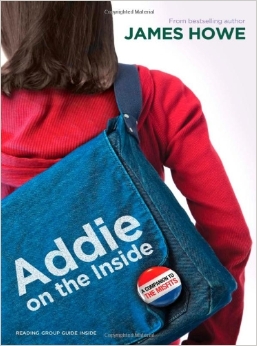
Addie on the Inside by James Howe


Grades 6 and up--

Intended audience: Middle school girls, GLBT tweens.

Audience to whom it will appeal: I think that much of this text could be relatable to boys as well as girls, though the initial interest would be difficult to attain given the cover and title. In order to promote this book to a wider audience, I would post some of the engaging, edgy poems from the book up in the Media Center. I think this book would also be an excellent and enjoyable read for parents or teachers of tweens or teens.
Strengths: Addie on the Inside realistically portrays the inner thoughts and emotions of tweens, both male and female. Addie calls middle school “purgatory…when so many things that never mattered before and will never matter again, matter.” Addie is outspoken, yet self-conscious, happy to be different, but wants badly to fit in; just like most of the middle schoolers I know. The anti-bullying sentiment sends a positive message and gives those wanting to speak up some literary courage. The author also incorporates a fair amount of homages to other YA novels and pop culture references, both of which give the opportunity to make connections outside of the text.
Weaknesses: For those who aren’t fans of poetry, the style of the novel may be a turn-off, although it alternates between free verse and rhyme-scheme poetry. Although I think the thinking, emotions, and experiences of Addie seem to be relatable to both boys and girls, the female voice of the narrator might be less appealing to male readers. The pop culture references are great, but they might be too specific to be accessible to readers in the next few years.
Special considerations: This novel is a companion to an anti-bullying series including The Misfits and Totally Joe that focuses on homophobia and GLBT issues. The books also cite and are supported by GLSEN (Gay Lesbian Straight Education Network). This would be a great book to use with a Gay-Straight Alliance in preparation for the National Day of Silence.
VERDICT: This is a book I would stock multiple copies of and would promote a large or small group reading of it for an anti-bullying group,GSA or even teacher PLC. This is a true middle school book and should grace the shelves of any and all middle school libraries.

Tuesday, March 8, 2016

I Remember Beirut by Zeina Abirached


Grades 6 and up--

This stunning graphic novel is compact, but powerful. The artwork is similar to the stark black and white drawings of Marjane Satrapi’s Persepolis and illustrate the divided world in which she lives: Beirut, Lebanon in the 1980s and 1990s. Written like a list poem, with each page or so beginning with “I Remember,” Abirached tells the story of her life growing up in a war zone.


Intended audience: Young adults interested in history.


Audience to whom it may appeal: I think this book could appeal to upper elementary students to grandparents, of all genders, races and religions. Its universal themes of memory and perseverance through struggle have the potential to provide connections for many.


Strengths: The artwork is visually very appealing. The solid black and white images are simple but captivating. The poetic style and repetition makes it accessible for a wider variety of audiences.


Weaknesses: Without much historical context, this book might be hard to understand, but it can also stand on its own as a story of a young girl’s life and all of the things she experienced. Although the prose and dialogue are relatively simplistic, there are historical and cultural references that will likely be missed by students with little background knowledge.


Special considerations: The book is a companion to A Game for Swallows which focuses on one particular night during war time.

VERDICT: This book would make a great addition to either the graphic novel or history section of any upper elementary through high school media center. The accessible format will appeal to lower readers, while the historical content might entice higher level readers to try a new format: graphic novel.

Wednesday, December 9, 2009

Maus by Art Spiegelman


Art Spiegelman's father Vladek is a survivor of the Holocaust. Maus is the retelling of his experiences before, during and after the Holocaust. Set in Vladek's home over a number of afternoons, the story follows the thread of the father and son's conversation and covers everything from Vladek's romantic relationships, his wife (and Art's mother)'s suicide, to his absolutely terrifying experiences in Auschwitz. Spiegelman is an artist and the text is written in graphic novel form in which each of the groups of people is represented by a different animal. It is a new take on a story often told in a traditional novel style.

Overall, I cannot say that I particularly enjoyed the novel, though I can see its value. Although I have not read many graphic novels, I will say that I enjoyed all of them more than I did Maus. For some reason I couldn't get into the story. Perhaps it was the fact that there were multiple plot lines occurring simultaneously, or that it was so non-linear? I am not sure. However, I do see how Maus could be a useful text in a middle school or high school language arts class. Sporadically including graphic novels is a great way to "spice up" the curriculum and keep your students on their toes. It would be a good text to pair with perhaps The Diary of Anne Frank or Night as it would give an alternate perspective (the Polish experience) and present visual images to elicit potential discussion.

Sunday, November 15, 2009

Review of: Little Brother by Cory Doctorow


Doctorow, Cory. (2008). Little brother. New York: Tom Doherty Associates, LLC. 978-0765319852.

 Marcus Yallow is a high school student senior with an incredible talent for technology. When he and his friends are caught up in the aftermath of a terrorist attack in San Francisco, they are arrested by the Department of Homeland Security and taken in for questioning. Upon release, they discover a police state in place of their city and must use their ingenuity and computer skills to undermine a power hungry government. Written in succinct, yet elegant prose and spoken from the voice of Marcus himself, this story brings to the surface important issues of personal and intellectual freedom, privacy, and power while treating the reader to an important coming-of-age story.
Cory Doctorow’s fast-paced, apropos novel draws in its reader from the very first scene. Marcus Yallow is a 17-year-old computer nerd on a mission. Skipping school one day to attend a gaming session for the brand new Harajuku Fun Madness online game, Marcus and his friends get caught in up in the frenzy of a terrorist attack and are soon captured by suspicious Department of Homeland Security (DHS) officers and taken to a far away prison. Inside, the friends are separated tortured for information. Upon release, Marcus, Jolu (Jose Luis) and Van (Vanessa) return to their families only to discover their former home has been turned into a near-police state in which everything and everyone is under full-time surveillance. Marcus takes on the task of undermining the DHS, freeing his community from the constant invasion of privacy and proving himself innocent through his brilliant computer skills and innovation.
Little Brother is a timely tale that broaches sensitive and controversial topics like freedom, privacy and terrorism while tying in actual government agencies and policies like the DHS, Guantanamo Bay, and The PATRIOT Act. Doctorow has created a frighteningly possible world in which technology rules and the government is omniscient this book will remind readers of the Orwellian world of 1984 (hence the name “little” brother and the protagonist’s avatar, w1n5t0n). With gait-recognition software, untraceable Internet (Xnet) and instant messaging programs (IMParanoid), Doctorow creates an incredibly advanced technological world that only a fantastic science fiction novel could offer. The scene he sets for the reader is wildly imaginative yet at the same time entirely plausible; the perfect setting for a novel that aims to challenge one’s perceptions to the core. Not only does Doctorow take great pains to describe his technology, but his characters as well. Marcus and his friends are likeable, realistic teenagers from incredibly broad backgrounds. They are diverse in culture, race, socio-economic status, gender and intelligence. Doctorow has done a great job of creating a space in which each character is recognized for his or her brilliance in a particular area. This underdog story gives hope and much-needed agency to teenagers from all walks of life. Although much of the book revolves around the tech-savvy teens attempts to rescue their family and friends from the increasing clutches of the government, Doctorow does not fail to include the unbearable, emotional, intense excitement of adolescence.
With incredibly well written prose, intense issues and robust characters, Doctorow has created a novel that will open minds and spark discussions for years to come.
Little Brother was awarded the 2009 White Pine Award, the 2009 Prometheus Award and the 2009 John W. Campbell Award.

Here is a link to the book website, on which you can read interviews with the author, further information on the book and DOWNLOAD THE ENTIRE BOOK FOR FREE!

Monday, November 2, 2009

Airborn by Kenneth Oppel

Now this is what I call fantasy. Oppel takes us on a journey of mystical creatures, fantastic ships that ride on air, and gives us an epic battle that forces us to the edge of our seats. The best part of this book was that I was able to suspend my disbelief in order to enjoy the book and this is what makes a quality fantasy text. I loved this book. I was completely enthralled by the majestic nature of the airship and loved imagining every element Oppel described. To top off this incredible setting and description of this fantastical story, Oppel also provides his reader with a humble, brave and likeable protagonist. His love and respect for the Aurora is what ensures the reader loves it too—the way in which he personifies it makes it an admirable character of its own! The best part of Matt Cruse’s character is his respect for the rules and regulations of the ship—his adherence to the tradition and structure of the ship is what makes him so charming. When Kate invites him into her first-class cabin, he very politely declines: “Thank you, miss, but I can’t…I’m crew, not a first class passenger. I can’t just sit down in your stateroom!” (100). It is fitting, then, that he is skeptical of Kate’s conjecture of the magical creatures she believes her grandfather saw. However, like Mina in Skellig, Kate helps Matt to see and believe in things beyond reality. For many teenage boys, the undivided attention of a beautiful young girl would be appreciated and reciprocated, but Matt does not interpret it this way. He does not want anything to get in the way of his potential promotion, even if she is beautiful. The way he talks about the Aurora allows the reader to understand her as practically human—the one constant in Matt’s life, his home. He even uses female pronouns to describe the ship, and does everything in his power to protect her from any and all evil. “The idea of the ship being sawed up like a cadaver made me feel faint. My home, left in ruins, ever to fly again” (281).
The other element that I particularly enjoyed within this text was the author’s connections between the characters on an almost spiritual level. Matt is connected to Kate because he is the one who sights her grandfather; they are both connected to the pirates through the cloud cats and Kate’s grandfather’s presence on the island, etc. These types of connections make a complex text like this more enjoyable because they allow the reader to comprehend the text on an even deeper level.
Not only does Oppel provide us with a magical airship, but we meet mystical creatures and there is a battle to overtake the ship—all the excitement necessary to keep the reader engaged. Alongside all of the excitement, Oppel makes some pretty bold statements about the relationships between men and women and seems to be relatively feminist about the latter’s role in the world. He also comments on privilege versus hard work and the relationships between the classes. It is a smart, engaging and overall FUN book to read that I would recommend to young and old readers alike.